By Daniel Buckwalter
There was the exquisite as well as the melancholy of Gustav Mahler (but of course) and the work of a French composer from the 1920s that had one patron afterward believing he had heard a George Gershwin piece.
All of it made for a wonderful Sunday afternoon of music on June 28 at the University of Oregon’s Beall Concert Hall, part of the first weekend of this year’s Oregon Bach Festival.
With Natalia Ponomarchuk on the podium, the OBF Modern Orchestra, along with the UO Chamber Choir, performed Bohuslav Martinů’s elegant “Nonet No. 2,” Mahler’s sorrowful “Songs of a Wayfarer” (expertly sung by baritone Javier Arrey) and French composer Darius Milhaud’s 1922 piece, “The Creation of the World,” infused heavily with blues and jazz passages.
But I would like to focus on one other piece, simply titled “Humanity,” which brought out the UO Chamber Choir under the direction of Sharon Paul. Making its regional premiere, its orchestration is lush and fully engaging for the entirety of its 10 minutes.
Yet I wonder if it has the depth I was searching for from a supremely talented 31-year-old writer, composer and artist born and raised in Afghanistan who has to have seen more horror than I can imagine.
“Humanity” is composed by Milad Yousufi — a man with an amazing backstory — and was commissioned by the Refugee Orchestra Project, Music Worcester and OBF. It is heartfelt, to be sure, but I expected the libretto to have more vivid accounts of man’s inhumanity and be less about the protective instincts of dogs, cats, birds and other animals.
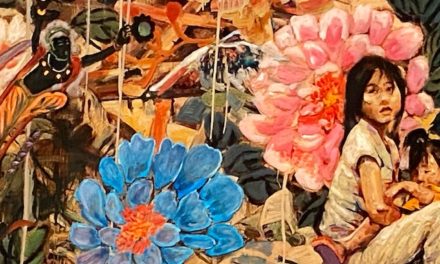
In the program notes, Yousufi writes that “Humanity” was inspired by a poem he wrote of the same name and by a painting he did depicting a father and son holding hands “formed entirely from flowing calligraphic lines,” emphasizing protection and unconditional love. He further writes that the work’s opening theme evokes “nostalgia for a time when compassion felt instinctive and humanity was defined by care rather than power.”
Perhaps I’m jaded, but in my mid-60s, as I depart daily the sanctuary of my own home with its three cats, perhaps I’ve been hard-wired to look for the sharp edges around me and the fangs of strangers. Like anyone, I have seen my own horrors, especially in the past few years.
Yousufi writes at the end of the program notes that “Humanity,” acknowledging the pain of loss and the end of innocence, offers, too, “a quiet plea: that we might relearn humanity from the simplest acts, from loyalty without reward, and from love freely given.” In short, humanity shown by animals.
I hope and pray that Yousufi and his generation fully experience that.
The Oregon Bach Festival continues through July 12. Concert and ticket information is available at OregonBachFestival.org. More information about Milad Yousufi is online at MiladYousufi.com.