
Note: Five performances remain of Lizzie the Musical at Oregon Contemporary Theatre — evenings at 7:30 p.m. Thursday through Sunday, Oct. 16-19, and a matinee at 2 p.m. on Sunday, Oct. 19.
By Daniel Buckwalter
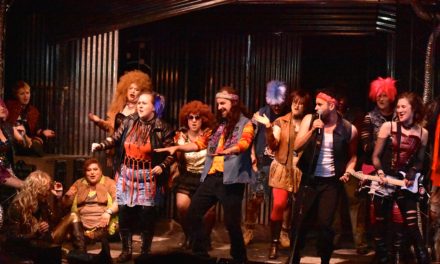
It is an electric, nonstop force of a musical with Abigail Moon, playing Lizzie Andrew Borden (“Don’t call me Elizabeth”), as its beacon.
Throw in the three other main characters — Emma (Kathleen Borelli), Alice (Kelly Finch) and Bridget (Jocelyn Kerr) — plus musical talent from Orchestra Next, and constant energy spills from the stage and fills the auditorium of Oregon Contemporary Theatre.
It is a treat to see.
One thing Lizzie the Musical — now playing at OCT with final four shows set for Oct. 16 through 19 — is not is a declarative statement on a simple question: Did Lizzie Borden kill her step-mother and then her father with 81 whacks of an axe combined as the long-ago ditty suggests? Or was it 29, according to forensic accounts?
Lizzie the Musical was first performed in 2009 with music by Steven Cheslik-DeMeyer and Alan Stevens Hewitt and lyrics by Cheslik-DeMeyer and Tim Maner, and it’s plain to see these three men believed she did it. So does the audience at OCT after the production directed by Brian Haimbach. So do I.
But did Lizzie really kill her parents in such brutal fashion in August 1892 at the Borden home in Fall River, Massachusetts? Where was the bloody axe handle or the bloody dress she was wearing? Why was there so little blood anywhere besides on the deceased bodies?
Why were there so many contradictory statements from Lizzie, her older sister Emma, as well as Alice and Bridget? Were Lizzie and Emma about to be written out of their father’s considerable will, with all the money going to the stepmother?
Were the father and stepmother controlling to a fault, perhaps abusive? Did Lizzie suffer from mental illness, or was she a manipulative figure who could expertly weave mind games with people and control the narrative?
Lizzie the Musical brings up all of this, yes, but doesn’t settle on an answer, and it’s just as well. Less than a year after the murders, and with a high-power defense team headed by Andrew Jennings and George Robinson (the onetime governor of Massachusetts), a jury of 12 men acquitted Lizzie of the murders in just 90 minutes after a two-week trial that captured the country’s attention. She was free.
The musical concludes there with Lizzie singing about the end of the whispering, finger-pointing and staring from Fall River residents and the start of a new life sharing a Victorian house with Emma in Fall River.
It may not have been that clean for Lizzie. According to the website UtterlyInteresting.com, Lizzie “faced rejection from many residents there and in the Central Congregational Church. Lizzie became a curiosity in Fall River, trailed by children and subjected to stares whenever she ventured out in public. Seeking solace, she retreated to her home, only to be bothered by local kids with pranks. Four years post-acquittal, a warrant was issued for her arrest in Providence on charges of shoplifting, which she apparently resolved.”
That would not be the end of it, either. More than 130 years after the double murder, there is something called the “Historic Lizzie Borden House: America’s Most Haunted House” in Fall River (lizzie-borden.com), open daily 10 a.m. to midnight and hosting “special and uniquely fantastical events that are not to be missed, including re-enactments, photo ops and haunted story times.”
Put all that aside, though, when taking in any of the five remaining performances of Lizzie the Musical. The singing and acting are first rate, and Moon playing the role of Lizzie is a treasure. You’ll be glad you went.