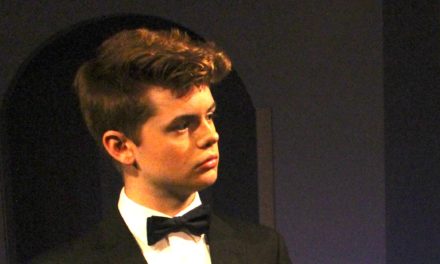

By Daniel Buckwalter
So much has been lost — lives, dreams and ambitions. At the end of the play, it’s nearly impossible for the characters of Radium Girls to make sense of it all.
But Arthur Roeder tries. He is a broken man now, never able to regrow the threads of moral decency that he once possessed. His sterling business reputation as a CEO, which he had worked so hard to cultivate, is gone. He stands at the cemetery, a healthy distance from Kathryn’s tombstone as Grace Fryer paints watercolor landscapes.
He does not look at Grace. He never has, and he never will. Grace knows this, and it makes her more angry. Instead, Roeder mumbles about misgivings to his adult daughter and finally, sadly, notes that “I never saw their faces.”
No truer words are spoken in Radium Girls, a profound and gut-wrenching play that began an eight-performance run on April 17 at Hope Theatre at the University of Oregon and runs through May 3.
Directed by Willow Norton Zolan, Radium Girls is a must-see production with a 10-member cast that expertly shines a spotlight on all the angles of courtroom and boardroom drama as well as the personal destruction these decisions create for the common workers and their families.
Indeed, I have seen my share of theater productions at the UO — all of them good — and Radium Girls is the best. I urge everyone to see it. A century later, the story still resonates.
The play, written by D.W. Gregory in 2000, is based on the true story of a radium factory in Orange, New Jersey, at the outset of World War I. Roeder (played by Jesse Brown) is the new CEO after the company’s founder, Von Sochocky (actor Mason Bruderer) retires, and Roeder has big plans for U.S. Radium Company.
But the market for radium — and its promise to cure cancer, among other ailments — is saturated. Worse, workers are quitting. Worse still, many workers have become sick. Some are dying, and the threat of lawsuits is in the air. U.S. Radium Company is starting to fall apart, and everyone is on the defensive.
It is the personal dialogue between the characters in the second half of Radium Girls that I found the most enlightening. It is dense, rapid-fire, poignant dialogue that all the actors nailed on opening night, and it gives the play its heft. These are the honest moments of angst and reflection where the residual effects of greed are —finally — being examined by the characters.
In particular, there’s the deep conversations between Roeder and his wife (Ivy Shankle), Grace (Dusty Stratton) and her mother (Jane Treadway), Grace and her fiancé Tommy (Teddy Skyler) as well as Roeder and Sochocky.
Truth pours out, and relationships are forever altered.
Only Stratton and Brown have singular roles in the UO’s production of Radium Girls. Everyone else has multiple roles to play, and I would like to single out one role, that of Miss Wiley (Maylie Knapp), a labor activist who advises Grace.
At the end of the first half of the play, Grace declares to her that she is justifiably angry at the company and wants justice, but Miss Wiley counters that, “The public doesn’t have much sympathy for an angry woman.”
Not much has changed in that regard, or with the punishing greed of big corporations in the century since, and that’s why the story behind Radium Girls still resonates. I urge you to see it.
Radium Girls at the UO’s Hope Theatre
When: Evenings at 7:30 p.m. on April 24 and 25 and May 1 and 2; matinee performances at 2 p.m. on April 26 and May 3
Where: Hope Theatre, 1109 Old Campus Lane, University of Oregon campus (Just off East 11th Avenue, between its intersection with Kincaid Street and its merger with Franklin Boulevard)
Tickets: (Free to UO students who present valid student ID beginning one hour before showtime); $10.25 for non-UO students, UO faculty/staff with valid ID, senior citizens age 65 years and older, and youths under age 17 years accompanied by an adult; $12.25 for adults; available online at ticket.uoregon.edu/radium-girls/4973