
Above: Eugene artist David Diethelm explores the use of thin paints in creations that are part of an exhibit of his work, Awash in the Flow, at The New Zone Gallery in Eugene.
By Randi Bjornstad
Fans of Eugene artist David Diethelm might well be interested in an exhibit of his work titled Awash in the Flow, on display through the end of May at The New Zone Gallery in downtown Eugene.
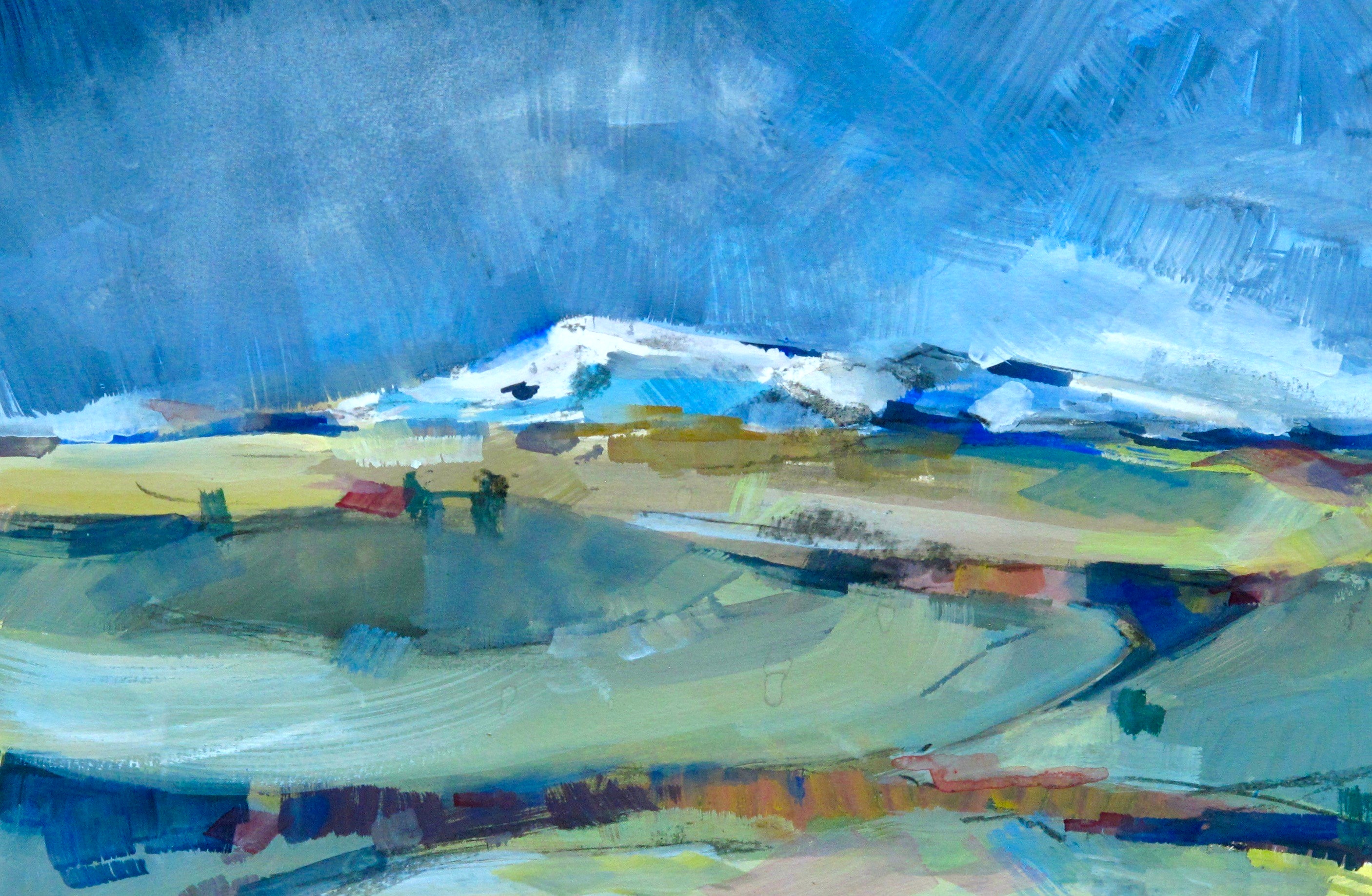
It’s a departure from much of Diethelm’s previous work because it involves a new experiment — using very thin paint — that results in a very different look from much that he has done before.
“I had done bits of this style before in other paintings, for things like drips and stars,” Diethelm explains. “So this was in the back of my mind, but about two-and-a-half years ago I bought some new paint that turned out to be super-thin. It just flowed and made me paint really quickly. It really just kind of reformed things.”
Oil paints generally offer a wide range of possibilities, “from the appearance of watercolor to solid surfaces,” he says, so he began to experiment.
“I started with green and blue, almost the way Rothko might, just kind of spontaneous, with splotches of yellow and just let them run. It just worked, and the thickness of each paint gets a different result.”
Maybe, Diethelm admits, that’s why he subtitled this show, The Optimistic Struggle.
“When you’re struggling with a new idea that you really want to get out, you’re optimistic that it will work, and at the same time making art is sometimes a struggle, but also enjoyable,” he says. “And in doing these, there were none that I started over — if something didn’t seem quite right, I just kept painting.”
Of all the pieces in this show, “all but two were done during the last nine months,” he says.
Trying this new style was an education in itself because of the spontaneity of thin paint.
“With thicker paint, you can’t cover as much area of canvas, so it takes longer and you have more time to think and realize what might be going wrong with it,” Diethelm concludes.”
At the same time, he realizes that famous artist Jackson Pollock’s work, who often relied on splattering in his paintings, “was probably a lot more deliberate than people gave him credit for.”
Another element in completing a paintiing in this style involves “drying it by standing the canvas up,” Diethelm says. “That gives the different thicknesses of paint different lengths of time to do what they want to do.”
His affinity for art began in earliest childhood, when as a toddler he was “painting with water on the hot sidewalks of Phoenix, Arizona.”
His family relocated to Eugene when he was 2 years old, when his father came to the University of Oregon to teach landscape architecture, serving for many years as head of the department.
“Creativity was in my genes, I think, and I had the full support of my family,” he recalls. “The most amusing story that I remember is that when I was in pre-kindergarten — not quite 5 years old and drawing with color crayons — the school officials contacted my parents and said they were concerned that I was using too much black. My parents made it clear not to try to control my art — they were very protective.”
By the time he reached high school, “It was pretty clear that I was going to be an artist,” Diethelm says. But one thing he still doesn’t do is to paint people, “because that requires a really different approach, with a lot of underlying technical structure.
“I’m not as interested in that, but more in the emotional aspect of a painting and also considering how the paint wants to act physically. Sometimes it goes the way I think, and sometimes it turns out really different.”

Storm Approaches Our Little Eden, one of artist David Diethelm’s works on display at The New Zone Gallery through May 2026.