
By Kelly Oristano
For myself, there is no balm or panacea for the troubles of our present age to be found in the theater. No earnest monologue or cutting barb will pierce the thrall of whatever dark magic has shrouded our national psyche. Six years ago Eugene’s own Very Little Theatre mounted a very edifying production of It Can’t Happen Here. Four years after that It Happened Here. It’s fair to say I’m bearish on our prospects.
Lauren Gunderson’s 2016 comedy, The Revolutionists, onstage now at the selfsame Very Little Theatre — and, as Maggie Hadley observes in her director’s note, onstage across the country in high volume this year — looks on paper to be aiming for a save-the-world timeliness. And I’ll start by saying that there’s plenty in this play that people need to hear, and need to hear from women and women of color. But I’ll continue by saying that while it dazzled upon its debut a decade ago, The Revolutionists hits decidedly different during this decade of democratic decay.
Equal parts French Revolution comedy, historical fiction character study, meta-drama (a play about a playwright writing a play,) and contemporary political broadside, The Revolutionists plays at age 10 like a quaint sepia photograph of our last vestiges of institutional democracy. One can see how this mix of styles and forms sizzled in the waning years of the Obama glow, but in this era, the high-minded political exhortations clash with the winky theater people in-jokes. It’s jarring to see an impassioned speech upon the guillotine scaffolding which appears to urgently address our current crisis followed immediately by a cheeky Les Miserables joke. At root, things that were distant and funny and cute in 2014-2015 are no longer distant, and rarely funny or cute in the cold light of fascism. It’s not Gunderson’s fault; like Cassandra, she was trying to tell us. Like humanity, we didn’t listen.
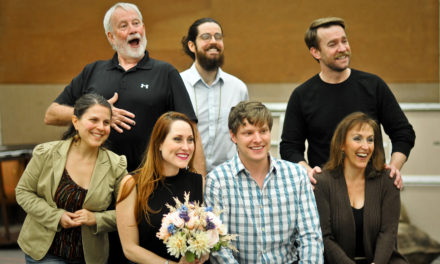
And if audiences across the country will be feeling this frisson this year, at least VLT’s is a quality production. Hadley is always excellent at casting, demonstrating both that she can attract the best performers and put them in positions to do great work, almost always in service of excellent plays by women. She has succeeded here again, finding an ideal talent for each of four exciting roles.
Jocelyn Kerr stars as Olympe de Gouges, a playwright attempting to write something in aid of the revolution, which is happening outside her window at all times without yet having involved her directly. Kerr is a brilliant comic actor who carries the show with her energy and wit. We are lucky to have her. This production succeeds largely on Kerr’s ability to help the audience know how to feel about all the fast-breaking news being dumped on us throughout. Her attempt to keep up with the pace of the revolution is not dissimilar to someone trying to wade through the “flood the zone” chaos of the current regime, and her growing exasperation felt uncannily familiar.
The first character to enter Olympe’s play, and her drawing room, is Marianne Angelle, played by UO first-year and VLT first-timer Anesu Chipanera. Angelle is a Haitian abolitionist and freedom fighter working to form friendships and find funding in France while her husband fights on Haiti’s front lines. Chipanera’s Angelle is smart, quick, and bitingly funny. She’s usually the closest thing in the room to a voice of reason.
Melanie Moser is Charlotte Corday, remembered by history as the person who stabbed Marat in the bathtub. Corday is darkly drawn to solving the revolution’s many problems with a knife, and has a meticulous reasoning as to why killing Marat would be a rational act in aid of the revolution and certainly not an indicator that she herself is mad. Moser’s well-known intensity of voice and eye are more than well-suited to this role, they’re a perfect match.
The last and perhaps most surprising personage to enter Olympe’s play is the original It Girl, Marie Antionette, played to the absolute hilt by Tracy Brous. Gunderson’s Marie is a ditzy-but-wise crown jewel of a comedic role demanding a smart and larger-than-life actor. While enjoying Brous’ Marie, I became convinced that the only actor who could improve upon her portrayal would be Miss Piggy. Please understand that this is a compliment of the highest order. The performance has to be seen to be believed.
The gowns and wigs are beautiful and feel authentic, though that authenticity clearly hemmed in all four actors, the tall wigs and wide hip bustles limiting them to standing straight, gliding carefully to a new spot for standing, and sometimes carefully sitting in the one chair. This is, of course, as it was and makes a statement of its own, but it occasionally felt a bit stolid. The set, which combines Rococo living chamber touches with the brute efficient carpentry of a gallows, is interesting in that stark contrast, but perhaps a little underutilized in practice.
Returning for a moment to the material and the odd patina that this odd decade has applied to it, we know a little about Corday, the beautiful, “troubled” farmgirl assassin. We know a bit more about De Gouge, a playwright, revolution-friendly, and composer of the Declaration of the Rights of Women. We know quite a bit about Marie Antoinette, though much of it is myth. But regardless how much we know, we know that they were all real women who really lived and really died.
The realization that things that played to our comfort a decade ago play to our discomfort now is an upsetting reminder of our recent fumbles, but we have to get up on Monday morning and watch the game film if we ever want to get better and beat these guys in the playoffs. And there are greater discomforts than a good-but-dissonant evening at the theater in the offing if we don’t get back on the ball.
The Revolutionists at The VLT
When: Evening performances at 7:30 p.m. on April 2-4 and April 10-11; matinees at 2 p.m. on April 5 and 12
Where: The Very Little Theatre, 2350 Hilyard St., Eugene
Tickets: $26, except $21 on Thursday, April 2; available through the box office at 541-344-7751 or online at thevlt.com