
By Daniel Buckwalter
It is the fragments that small children remember in a time of crisis — vivid memories of scenes, to be sure, but never enough of context to stitch those memories together to form a baseline narrative to the whole story.
That also may happen in adulthood, and the results can be jarring, especially if a foundational truth had been kept from the children for years, a boulder-sized piece of a puzzle that would have that would have allowed them to neatly fit the smaller fragments together and understand the truth of a life-altering event.
Such is the case with Three Decembers, a deeply moving chamber opera that had a soulful two-performance run on May 29 and 31 by Eugene Opera in the Hult Center’s Soreng Theater, and the final performance of this, its 49th season.
It was all part of a busy weekend for Eugene Opera. The company also had its annual fundraiser (“Arias in Bloom”) on May 30 at The Shedd Institute.
But Three Decembers was the star of weekend. This opera, premiered by the Houston Opera company in 2008, is based on an unfinished play by the great playwright Terrence McNally, with music by Jake Heggie and libretto by Gene Scheer.
Eugene Opera’s production was directed by David Gately, and the 12-member chamber orchestra was directed by Andrew Bisantz.
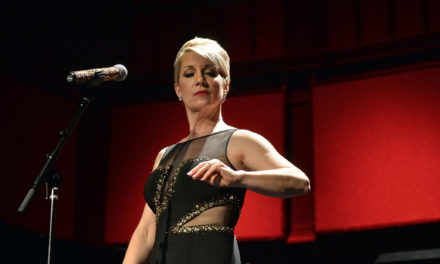
Mezzo-soprano Emily Pulley starred as Madeline Mitchell (Maddy), the self-consumed, Tony-award winning actress who became a widow at age 26, after, the story goes, her pedestrian husband was killed after being hit by a motor vehicle. Their children were very young, and she was forced to raise (in a distant manner) daughter Beatrice (soprano Ivy Zhou) and son Charlie (baritone Phillip Bullock) on her own.
Maddy would rather not have had anything to do with raising children. She was focused on the angst and fulfillment of her career — the stage, the spotlight, the adulation. It was her addiction, a fact that Beatrice forgiveingly, and gracefully, notes at the end of the opera, at a celebration of life after she dies.
But in those three Decembers between 1986 and 2006, an introspective time of year and where the opera is centered, it is revealed how out of touch Maddy really is. Beatrice is adrift, alcoholic, with a philandering husband. Charlie, who is gay, is dealing with a partner, Burt, who is dying of AIDS. Maddy can’t bring herself to the partner’s name correctly, calling him Curt and infuriating Charlie.
Finally, there’s that boulder-sized secret Maddy’s been keeping: The father of the two kids did not die in an accident. Rather, he died by suicide, stepping in front of a subway. Nothing she had said earlier about an accident was real. Nothing — none of the fragmented puzzle pieces the kids thought they had in front of them — was real. The family disintegrates, and Maddy is left alone at the end of Part 2.
Eugene Opera’s production of Three Decembers was, as noted earlier, a heartfelt look at parents who keep family secrets and obscure fudge the truth, in order to keep life moving. The cast ardently played their roles.
It was absorbing, and profound enough that two days after the performance I attended, I’m still processing it.
Well done, Eugene Opera.