
By Daniel Buckwalter
There was the glorious and transcendent music from the Italian Renaissance and Baroque eras that breathed enchantment and grace to the audience — and just for the sheer fun of it, a little of The Beatles.
More on that later.
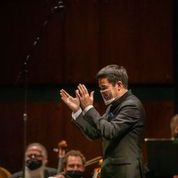
Eugene Vocal Arts — the near 40-member chamber choir under the direction of Diane Retallack — took audiences on a delightful walk through Italian repertoire Nov. 15 and 16 with a program titled La Bella Vita in The Hult Center’s Soreng Theater, and the 90-minute concert was a balm (a perfect escape, really) from the daily swirl of assaults to the senses.
It was grace.
The choir — joined by the Eugene Vocal Arts and Eugene Concert Orchestra, soprano soloists Arwen Myers and Ágnes Vojtkó as well as organ, harpsichord and harmonium soloist Barbara Baird — performed works by Giovanni Gabrieli and Giovanni Perluigi da Palestrina (each from the biblical Book of Psalms), Orazio Vecchi and Luca Marenzio.
Moving on to the Baroque era, there was the wonder of Barbara Strozzi’s Le Era Grazie e Venere and Claudio Monteverdi’s Lamento della Ninfa. Italian composers from the 20th century were explored with an excerpt from Luciano Berio’s Momenti, per nastro magnetic.
Then came Yesterday by The Beatles, sung with delicacy by Myers. Retallack admitted from the stage that this was a stretch, but she pointed out that Berio, an avant garde composer who specialized in electronic music in his day, was personally acquainted with The Beatles, and he had his own arrangement of Yesterday with organ and cello. I would have liked to have heard it sung in Italian just to hear how that might work, but Myers was wonderful. It was a joy.
The program returned to the Baroque with Antonio Vivaldi’s Magnificat to end the first half of the program, and I was particularly struck by the exquisite soprano and mezzo duet by Myers and Vojtkó in the sixth movement (“Esurientes Implevit Bonis”). I could have heard that a couple more times.
After intermission came selections from Giocchino Rossini’s uniquely-named Petite Messe Solennelle, composed in 1863. As Retallack noted, there’s not much that is petite about this mass as it clocks in at 90 minutes.
The highlight was Prelude Religieux and an eight-minute solo performed by Baird on the harmonium, known also as the reed organ. Asked to describe her work on the instrument, Baird noted that she used both her hands and feet and even her knee to help pump air into the instrument. “It’s a full-body experience,” she said.
La Bella Vita was a fine way to introduce Eugene Concert Choir’s 51st season — and whet the appetite for more.