By Daniel Buckwalter
Isolation and loneliness. It can, and does, happen almost anywhere, and the humiliation of not being seen and loved as you are can lead, through time, to drastic actions and catastrophic consequences.
It need not happen only in the dreadful and vast moors area of England in the 1840s, as American playwright Jen Silverman expertly lays out in The Moors, their play which premiered in 2016 and now has an eight-performance run at Hope Theatre in the Miller Theatre Complex at the University of Oregon. It opened Nov. 7 and runs through Nov. 23.
Isolation and loneliness can corrode and extinguish the life of a beloved family member and any person you encounter on the streets. It can be seen in the workplace and, in particular, with social media.
It’s everywhere in our socially divided culture, mental health chipped away one painful sleight or physical assault at a time, until empathy dries up and the victim feels he or she can only be heard by lashing out.
The Moors is a dark comedy, and it makes no pretense otherwise. Everyone is love-starved, and Director Tricia Rodley, in notes with the program, points out that “This play becomes a window into ‘1840s-ish’ that reflects back into the now because each character’s attempt to be seen (including Mastiff and Moor-Hen) might look a little like our own paralysis, or defensive joy, or aggression or despair.”
The six-member cast of the UO’s production of The Moors does a wonderful job of conveying the anger, heavy sadness and despair that each character carries.
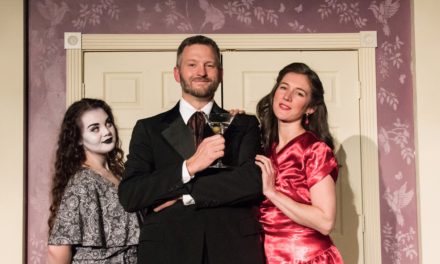
There are the spinster sisters Agatha and Huldey. Agatha (Annaliese Johnson) is the older, authoritative sister who runs the drab and lifeless mansion in the desolate moors region — where every room looks strikingly alike. She wants power, pure and simple, and all things are transactional. “There’s nothing more dependable than self-interests,” she tells the governess Emilie.
Huldey (Sierra Matz) is the meek, diary-driven younger sister who endures the merciless taunts and insults of Agatha. She wants love and life. She will get neither.
There is Marjory the maid, but you can call her Mallory or Margaret. She (Ivy Shankle) goes by all three. She is pregnant, inflicted with typhus, and is cold, detached and calculating. Shankle is commanding in the role with evil eyes that pierce the soul of anyone in front of her.
Innocently walking into all of this is Emilie (Ray Cyphers), who has corresponded and made a connection with what she believed was the older brother of the house, except he may be holed up in the attic of the mansion, fed one thin meal a day. Now far from the active London she had known, Emilie has to navigate the toxic and treacherous mansion in the moors moment by moment.
My favorite characters are Mastiff (the lumbering dog played by Nathan Vandehey) and Moor-Hen (Violet Hamilton). They meet when Moor-Hen crashlands after flight and injures a leg. After much negotiation, Moor-Hen allows Mastiff to help her out.
It’s the animals that bring the childlike honesty of the play, especially Mastiff, who has been terrorized by Agatha and ignored by the others. But when Moor-Hen heals, she wants to fly again. Mastiff wants her to remain, and they argue.
Mastiff is at wit’s end, and it doesn’t end well for Moor-Hen. Huldey hears one insult too many, and it doesn’t end well for Agatha.
The characters in The Moors, in a sense, cannibalize each other, and I fear that will happen in our society, if it hasn’t already. The Moors at the UO may not be for everyone, but I highly encourage people to attend any of the remaining six performances, if only to allow the cast to hold a mirror up for us to see ourselves.